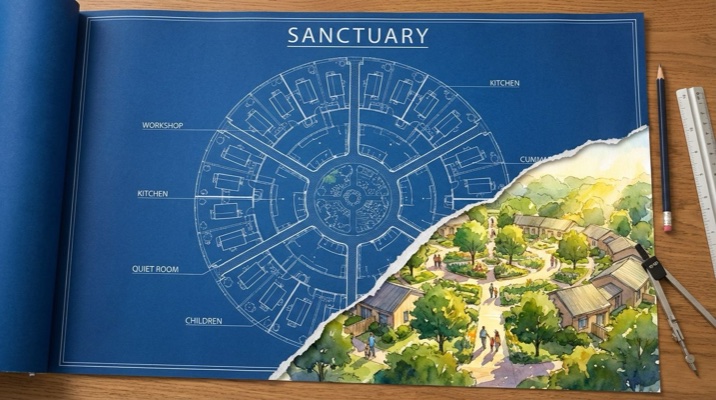
Sanctuary Design
Alex Applebee & L. N. Combe
Sanctuary Design
11,711 words · ~78 min
Generate Audio
ElevenLabs TTS. Paste your API key below.
Sanctuary Design: A Zoological Framework for Human Systems
Alex Applebee and A. D. Masters
Author's Foreword: Why This Thesis Exists
This thesis did not begin in a library. It began with a phone call that arrived too late, a system that punished the wrong person, and a child who is no longer here.
The fourteen goals that drive the OMXUS project are not policy proposals. They are prevention requirements. Each one traces to a system that broke a real person. Three of those goals are the direct subject of this thesis:
Goal 4 (replace courts with restoration) (replace courts with restoration): Eradicate courts. Courts do not perform justice. They perform authority. They reward the people who put others in cages. This thesis proposes the replacement: direct approach, voucher escalation, town meeting, ViewSwap. Not because courts are imperfect and could be reformed. Because the architecture of courts -- adversarial proceedings, professional advocates, institutional memory that favours repeat players -- is structurally incapable of producing justice at the individual level. The data is in Part II. The alternative is in Part III.
Goal 5 (replace police with community response) (replace police with community response): Fire all police, justice, and corrections staff. The system provides wanted attention for unwanted results. It spends $32 billion per year in Australia and achieves 45% recidivism. The CAHOOTS model has run for 35 years. Zero people killed. Hatzolah volunteer responders arrive in 3 minutes. Ambulances take 14. The ring described in Chapter 7 reduces that to 60 seconds. The energy currently absorbed by a revenge system can be redirected into prevention infrastructure.
Goal 6 (re-employ displaced workers) (re-employ displaced workers): Re-employ all fired staff in functional positions. Nobody loses a livelihood. The skills transfer. T